AI in the Wild · Stanford d.school

The Asking Desk.

A school desk that gives you questions, not answers.

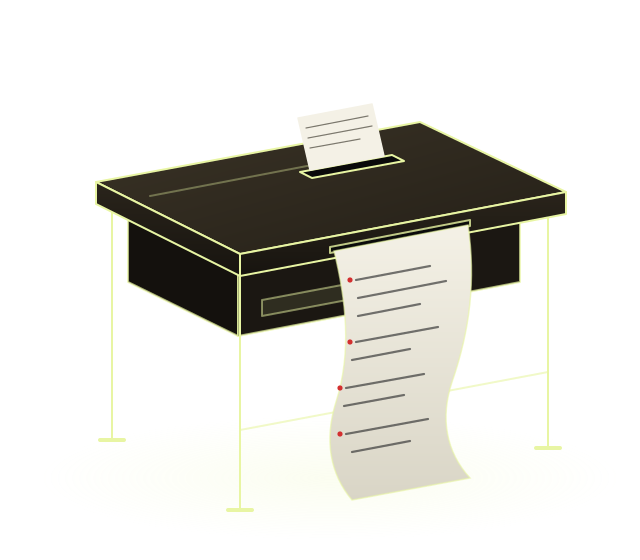
A school desk with a receipt of questions curling out of a slot
“Instead of putting answers inside the school … put questions inside.”
Marshall McLuhan, 1974
How it works

Write. Feed. Wait. Receive.

We often see school as a place where answers are handed down to us. But what if school helped us ask questions instead?

1

Write

Take a card. Finish two lines: I'm trying to ___ but ___.

2

Feed

Slide your card into the slot on the desk. The desk reads what you wrote.

3

Wait

The desk works for a moment. On purpose.

4

Receive

A receipt prints with questions from four families.

One visit, start to finish: 48 seconds, sped up while writing. No sound.Video: Leticia Britos Cavagnaro. Thanks to Adam Royalty for permission to use his likeness in the video.
Yes, AI

An AI model reads your card and generates questions aimed at expanding your thinking.

Want to learn more about how The Asking Desk uses AI? Chat with Leticia

Try it

Feed the desk a card.

Click on a demo problem. Watch what comes back.

These slips were written for this page so you can see the shape of one. At the desk, the AI writes yours from your own words.

THE ASKING DESK
waiting for a card…
The typology

Four families
of questions.

Every receipt spans all four families. The goal is to pull you across different kinds of thinking, not deeper into just one.

Sharpen

Pin down what's said and what's known.

ClarifyWhat do you mean by ___?
AssumptionsWhat are you taking for granted?
EvidenceHow do you know? What would count as evidence?

Rooted in Socratic questioning (Paul & Elder) and deep-reasoning questions (Graesser & Person).

Widen

Bring in other vantage points and consequences.

PerspectivesWho sees this differently, and why?
From experienceWhen have you faced something like this before?
ImplicationsIf that's true, what follows?

Rooted in Paul & Elder, and King's work on questions that connect to prior experience.

Deepen

Go under the problem.

A deeper whyWhy does this matter to you?
A bigger questionIs this the real question?

Rooted in elaborative "why" questions (Dunlosky et al.), Berger's why / what if / how, and research on problem finding.

Imagine

Open toward what could be.

What ifWhat if it were otherwise?
PossibilityWhen has this worked, and what made it possible?

Rooted in appreciative inquiry (Cooperrider & Srivastva) and generative design questions (Eris).

Why Imagine matters. Most question typologies are convergent: they assume an answer is out there to be found. Özgür Eris, at Stanford's Center for Design Research, found that about 15% of the questions design teams asked fit none of them. These were generative questions, asked to open possibilities rather than retrieve facts. Imagine keeps room for them.

Why questions

Answers got cheap.

What's scarce, and teachable, is the craft of asking good questions.

AI in schools has settled into one form: a chatbot, on a personal device, used privately, answering instantly. It's useful. It can also quietly do the thinking for you. Many educators now see work that passes the assignment but skips the reasoning it was meant to build.

Critical thinking depends on friction. On noticing what you assume. On staying with not knowing. On hearing a view you don't already hold. Good questions add that friction back.

  • Notice assumptions.
  • Weigh the evidence.
  • Sit with uncertainty.
  • Embrace ambiguity.
  • Borrow someone else's eyes.
  • Question the question.

What the research says

Asking is natural.

Young children ask questions right where their knowledge has a gap, often more than one a minute. Across the school years, that questioning tends to fade.

Chouinard, 2007 · Engel, 2015

Making questions builds understanding.

A review of intervention studies found that teaching students to generate questions improved their comprehension.

Rosenshine, Meister & Chapman, 1996

Deep beats lookup.

In tutoring, why, how, and what-if questions were linked to better learning than who, what, and when.

Graesser & Person, 1994

Your own experience is an anchor.

Questions that tied new ideas to students' prior experience worked better than questions that stayed inside the material.

King, 1994

Curiosity lives at the edge.

Curiosity peaks when you know a little, not a lot. A good question opens a gap you can feel the edge of.

Loewenstein, 1994 · Kidd & Hayden, 2015

Finding the problem is the work.

Art students who spent longer finding their problem made more original work. A meta-analysis of 40 studies confirms the link between problem finding and creativity.

Getzels & Csikszentmihalyi, 1976 · Abdulla et al., 2020

Note: Most of this research studies people generating their own questions. The Asking Desk hands you questions about a problem or situation people bring. The goal is to get them to think of questions they should be asking themselves.

Sources
  1. Abdulla, A. M., Paek, S. H., Cramond, B., & Runco, M. A. (2020). Problem finding and creativity: A meta-analytic review. Psychology of Aesthetics, Creativity, and the Arts, 14(1), 3–14. doi
  2. Berger, W. (2014). A More Beautiful Question. Bloomsbury.
  3. Chouinard, M. M. (2007). Children's questions: A mechanism for cognitive development. Monographs of the Society for Research in Child Development, 72(1), 1–112.
  4. Cooperrider, D. L., & Srivastva, S. (1987). Appreciative inquiry in organizational life. Research in Organizational Change and Development, 1, 129–169.
  5. Dillon, J. T. (1990). The Practice of Questioning. Routledge.
  6. Dunlosky, J., Rawson, K. A., Marsh, E. J., Nathan, M. J., & Willingham, D. T. (2013). Improving students' learning with effective learning techniques. Psychological Science in the Public Interest, 14(1), 4–58.
  7. Engel, S. (2015). The Hungry Mind: The Origins of Curiosity in Childhood. Harvard University Press.
  8. Eris, Ö. (2003). Asking generative design questions: A fundamental cognitive mechanism in design thinking. Proceedings of ICED 03, Stockholm.
  9. Getzels, J. W., & Csikszentmihalyi, M. (1976). The Creative Vision: A Longitudinal Study of Problem Finding in Art. Wiley.
  10. Graesser, A. C., & Person, N. K. (1994). Question asking during tutoring. American Educational Research Journal, 31(1), 104–137.
  11. Kidd, C., & Hayden, B. Y. (2015). The psychology and neuroscience of curiosity. Neuron, 88(3), 449–460.
  12. King, A. (1994). Guiding knowledge construction in the classroom. American Educational Research Journal, 31(2), 338–368.
  13. Loewenstein, G. (1994). The psychology of curiosity: A review and reinterpretation. Psychological Bulletin, 116(1), 75–98.
  14. Paul, R., & Elder, L. (2006). The Thinker's Guide to the Art of Socratic Questioning. Foundation for Critical Thinking.
  15. Rosenshine, B., Meister, C., & Chapman, S. (1996). Teaching students to generate questions: A review of the intervention studies. Review of Educational Research, 66(2), 181–221.
For educators

Bring questions
to your classroom.

No hardware needed. Six short activities that put the desk's moves in students' hands: write it down, wait, get questions back, keep asking.

ACTIVITY 01

Peer question coaching

15 min · pairs · index cards

  1. Each student writes a real problem: I'm trying to ___, but ___.
  2. Partners swap cards. Each partner becomes a question coach and may respond only with questions: one Sharpen, one Widen, one Deepen, one Imagine. No advice.
  3. The owner circles the question that moved their thinking most and says why.

Builds: The discipline of helping without answering.

ACTIVITY 02

Family sort

20 min · small groups

  1. Each student lists every question they asked (or searched, or prompted) this week.
  2. The group sorts them into Sharpen, Widen, Deepen, Imagine, and “just looking up a fact.”
  3. Discuss: which family is crowded, which is empty, and what that says about how we think.

Builds: Awareness of your own questioning habits, and words to stretch them.

ACTIVITY 03

Interrogate the answer

20 min · solo, then pairs · one chatbot answer each

  1. Give students a confident answer produced by artificial intelligence related to a subject in your course.
  2. Students list the questions the answer quietly assumed, and the ones it never asked.
  3. Pairs pick the most important unasked question and pursue it without the chatbot.

Builds: Reading an answer as the end of someone else's inquiry, not yours. Go further with Experiment 6.

ACTIVITY 04

Deal a Wild Card

15 min · pairs or table groups

  1. Each student shares a problem in one sentence.
  2. Others write a Wild Card: If your ___ were a ___, what would ___? Surprising, kind, and still connected sideways.Example: A visitor wanted a daily piano practice, but excuses kept winning. The desk asked: If your excuses formed a band and played a gig, what would they be called?
  3. The owner answers one aloud and names what the metaphor revealed.

Builds: Imagination as a tool for analysis.

ACTIVITY 05

Ask before you ask

10 min · solo · any task that invites AI

  1. Before opening a chatbot, students write three questions of their own and wait two minutes.
  2. Only then do they prompt the AI.
  3. Compare: what did the AI cover that they missed? What did their questions reach that the AI didn't?

Builds: A habit of friction: your thinking first, so AI extends it instead of replacing it.

ACTIVITY 06

Leave with a question

5 min · whole class · exit ticket or wall

  1. End class with the question each student is leaving with, not the answer they got.
  2. Post them on a wall or shared board. Open the next session with two or three.
  3. Over a term, revisit: which questions grew, which got answered, which were the wrong question?

Builds: The slip's last line, in practice: What if you kept asking your own questions?
1 / 6 Download all (PDF)

The six activities and the PDF are shared under a Creative Commons BY-NC-SA 4.0 license: use and adapt them freely for non-commercial purposes, credit the source, and share your adaptations under the same license.

Urgent questions

What's worth
knowing now?

In Teaching as a Subversive Activity (1969), Neil Postman and Charles Weingartner imagined a curriculum built from questions instead of answers. With AI ready to answer almost anything, their challenge is back on the table. What questions should learning be built around now?

0 / 280

Questions are reviewed before anything appears on this page.

From the author

Find Questions to
Your Answers.

An excerpt from Experiments in Reflection by Leticia Britos Cavagnaro, a d.school guide (Ten Speed Press, 2023).

The hypothesis: seeking questions instead of answers takes you to new territory worth exploring.

1 / 1
Keep going

Reflect with Riff.

What was your reaction to getting questions instead of answers to the problem you shared? Continue reflecting on this with the help of Riff, an AI reflection partner built at the d.school. Like the desk, Riff asks questions instead of giving answers, and it has helped more than 55,000 learners around the world make sense of their experiences.

Reflect with Riff

Your anonymous riff-lections will help Leticia Britos Cavagnaro understand your perspective on the value of questions for critical thinking and learning. What you share will only be used for this purpose and it will not be used to train AI models.

Connect with Leticia.

Leticia would love to chat with you about your reaction to the Asking Desk and your perspective on the value of questions.